
Português | English
By Thaís Nascimento
“I was a woman who needed luck,” said Rosinha de Valença in the 1970s in Rio de Janeiro. “A lot of willpower and little help,” said Pauliane Amaral about her sister’s life — guitarist Mayara Amaral, murdered in a femicide in 2017 in Mato Grosso do Sul.
Rosinha and Mayara – two Brazilian female guitarists and creators dedicated to their artistic work. And how they worked. Rosinha produced albums, performed solos and accompanied on guitar; composed, sang, published methods, formed a women’s group, hosted radio shows, and performed in several countries and on television (Oliveira, 2025).
For her part, Mayara completed an undergraduate degree and a master’s degree in Music and performed a wide-ranging repertoire for solo guitar, from the Renaissance to the present day. She published pioneering research on women composers for the instrument, taught with her guitar on her back, riding a bicycle, in various neighborhoods of Campo Grande; she also formed a women’s group and several instrumental ensembles, recorded, played at night, and was about to pursue a doctorate at Unicamp (Amaral; Soares, 2017; Amaral, 2025).
“I was reborn when I rooted my womanhood,” reports Thaís Nascimento, 31, a native of Porto Alegre, Rio Grande do Sul — the author of this text. I reached my doctorate through UFRJ and am immersed in an artistic research project that I have been developing since Mayara’s femicide. I started in music by composing songs self-taught, until I began studying in two social projects and entered the undergraduate Music program at UFRGS. I returned to composing when I was reborn in my personal and professional life, inspired by the theme of Music and Gender.
Thus, citing statements and works by female guitarists who inspire and permeate my feminist artistic research, I begin this text, which arose from the idea of reporting on my concert at the Fred Schneiter Festival, held in 2025 in Rio de Janeiro. In this concert, the program was one of the elements that did not emerge randomly, nor from an already established musical canon. Therefore, I address here the genesis of this performance and of this artistic-investigative project as a whole. After all, I started performing works by women and composing my own, not because they are part of a curriculum or an accepted and widespread social practice, but as a reaction to a patriarchal structure that denies and silences our productions and lives.
This is (not) a text about violence against women. It is about how relationships between human genders influence the creative practices of female guitarists. Which of us has never experienced any form of violence, whether in personal or professional life (if it is possible to separate them)? In this sense, the trajectories of three creative female guitarists — Rosinha, Mayara, and my own, Thaís — intersect, not only because they play the same instrument or were born in the same country, but also because of their gender identities. Throughout the text, other trajectories cross paths, such as that of Elodie Bouny, who led me to the news of Mayara’s murder and to the significance of seeing myself (and seeing myself anew) as a female guitarist and composer. It was necessary for me to see and re-see myself as a creative artist as well, since my practice of composition and performance — intrinsic to me from the moment music entered my life — was silenced and disqualified by the gender violence that structured my place as an interpreter and as a docile woman in my professional and personal relationships.
My earliest childhood memory, only recovered in recent years after these reflections on identity, is of picking up a guitar that was leaning against a wall in my grandmother’s house, in the metropolitan region of Porto Alegre, Rio Grande do Sul. When I was 10 or 11, I made a scrap guitar and wrote song lyrics. At 12, I received my first acoustic guitar, a student series model from a store. That was in 2006. Also at the age of 12, but a few decades earlier, in 1953, Maria Rosa Canellas (Rosinha de Valença) was already playing at dances in Valença, Rio de Janeiro (Marcondes, 1977). But how and when did both guitarists make it to the capital of Rio de Janeiro?
The sonorities — whether musical notes, timbres, guitaristic gestures, or spoken words — become narratives when I perform with my guitar. Not only at the moment of concerts, recitals, and soirees, that is, when I am with people who kindly come to hear me and/or appreciate the guitar. But each of the stages — creative choices, studies, compositions — in my home, with my instrument, and wherever I am, constitutes one of the narratives of my life, of other people, and of the creative female guitarists with whom I have been working (with them and with their works). This theme has transformed my artistic practice. It gives me and has given me more desire to live, to produce, and to disseminate my artistic research, in contact with musicians, researchers, and the general public.
Thus, with each artistic interaction, I bring narratives such as Rosinha’s in the performance of the video Porto das Flores – Rosinha de Valença, Performance by Thaís Nascimento. The guitarist arrives in Rio de Janeiro at age 22 looking for work as a typist, but ends up making a living from the guitar. When accessing Rosinha’s video and audio recordings today, the difficulties she faced seem to remain hidden, given that she was, after all, a female guitarist with such a broad and intense professional activity. On the other hand, we see the scarcity of available material about her work, as well as mentions of her guitar playing as part of the Brazilian creative practice for the instrument. Considering also her untimely death (cardiac arrest at age 50, followed by 12 years in a coma), we are confronted with yet another practice of silencing women’s production. The opening sentence of this text, “I was a woman who needed luck,” begins a statement by Rosinha in which she says that
“I was the only one against an enormous number of guitarists, a bunch of men who were not willing to give me a place. I almost had to tear the strings off the guitar so that people would understand that I knew how to play. How many times did I play extremely strong chords to wake people up, to make them shut their mouths for a moment and pay attention: when an artist plays, they must be heard. It doesn’t matter if they’re wearing a skirt or underwear.” (Jornal do Brasil, 1972 apud Baraúna, 2014).
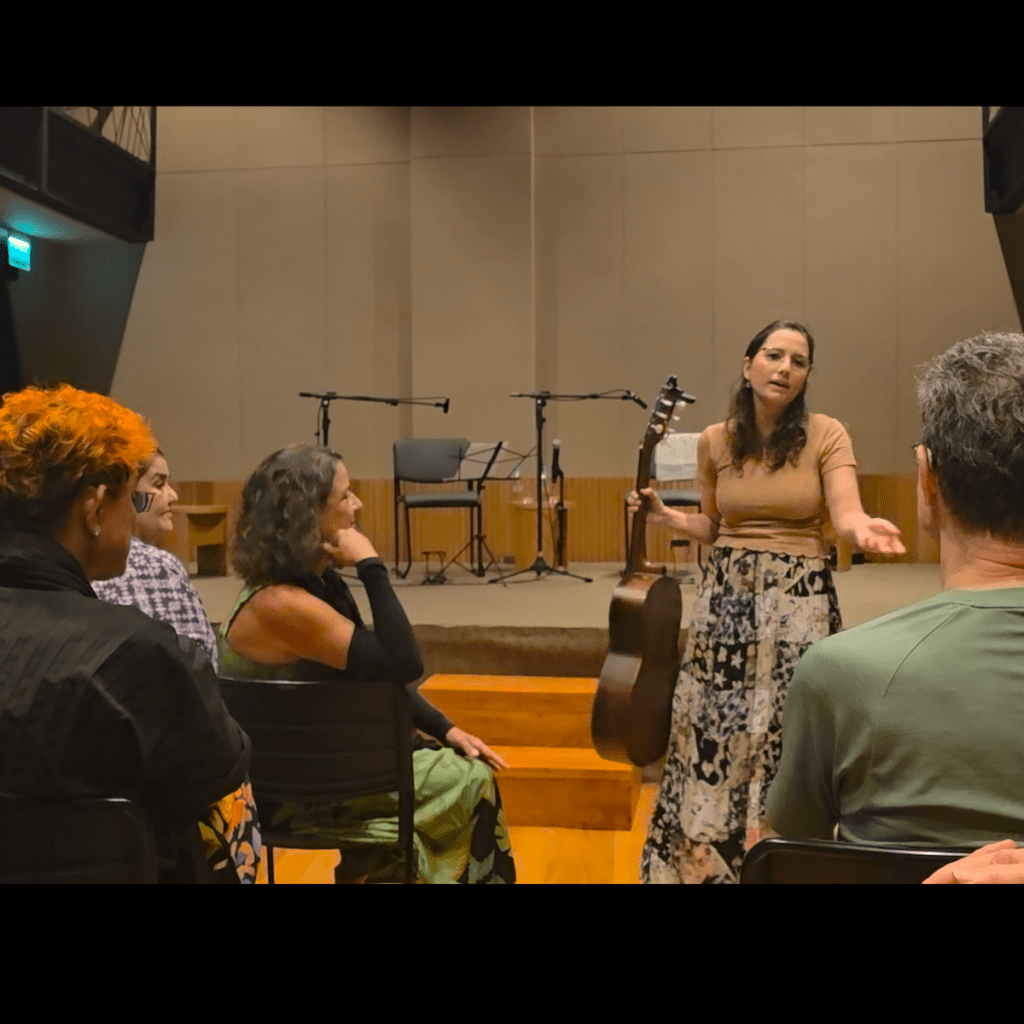
On the second night of the Fred Schneiter Festival, on July 25, 2025, there was an artist in a skirt on stage. I, the only female guitarist performing that night, thought about how to bring the narratives of other women onto the stage. Being there already represented that, but I was also there because my predecessors paved the way and continue to pave it (yes, I always speak of Chiquinha Gonzaga as our ancestor). On the other days of the Showcase, I noticed that there was a projector in the concert hall, above and behind whoever was playing. Therefore, I came up with the idea of not only talking about composers and guitarists throughout my concert, but also projecting their images.
I chose 100 guitarists from various countries, prioritizing Brazilian and other Latin American women, from a decolonial perspective and cultural affinity. The number was determined by the concert’s time constraints and the need to coordinate video production with instrumental practice preparation. Before the concert, I spoke with the sound and lighting team and arranged for them to pause the video each time I finished a piece. Then, in addition to talking about the musical piece I had just performed, I would also discuss the guitarist shown in the video.
I didn’t plan this, but all those who stopped at the agreed-upon moment were people I knew well, either personally or through work collaborations. After the performance of Rosinha’s “Porto das Flores” in the first video of this text, the projection stopped on an image of Luciana Oyhanarte, an Argentine guitarist and composer, member of the AIVIC collective – International Association of Women Guitarist-Composers. On that occasion, another founding member and director, besides myself, was present: Ximena Matamoros.
Since 2017, when I began this feminist artistic research driven by a sense of justice (that is, a sense of valuing my own life) and to honor Mayara, I have been working increasingly, uncovering repertoires by women for guitar, carrying out artistic-academic collaborations on the theme, and with them, building performances and compositions, thinking about and practicing epistemologies of respectful communication in all my work. In other words, it is not only about the musical content (works by women), but about how to be and exist in the world with people in a non-violent way.
This did not happen overnight. I was 23 years old and had experienced more than just one single situation of personal and professional violence. To cite one situation, I had stopped composing because I could not see myself in that role. But the contradiction is that, when I first became interested in music as a child, before I even had a guitar or access to music education, I spent a good part of my time composing. I continued to compose when I got my Giannini student series guitar, now adding chords and guitaristic gestures. But I stopped composing and stopped recognizing my own potential as such when I entered university and followed a curriculum focused on performing works by male composers.
It is a set of experiences, but Mayara Amaral’s master’s thesis, defended in March 2017 at the Federal University of Goiás, was my first reference for incorporating works by women composers into my guitar playing. I entered this narrative and discovered it to be collective, intertwined with the stories of other women. I began to dedicate myself more to my career as a researcher-artist, carrying out performances and academic publications. By listening to and telling my own story, I was doing so for many who could not and/or still cannot see themselves. I have been tirelessly disseminating my work, which has also brought me to Rio de Janeiro, where I am pursuing a Doctorate in Creative Processes in the Graduate Program in Music at the Federal University of Rio de Janeiro, in addition to performing and participating in events. The Fred Schneiter Showcase marked my year 2025 greatly, as well as my entire trajectory. Being, in the afternoon, part of the jury for the competition organized by the event, and at night, a woman concert artist performing works by women, made me feel illuminated not only by the sun of the day, but mainly by another vital element, of the night.
What do we hope for when we look at the sky at dusk, in the middle of the night, or in the early morning hours? That “There must be a moon”… title of the piece by Fred Schneiter that I performed at the showcase dedicated to him in Rio de Janeiro, on July 25, 2025. A symbolic date in many ways. Around the second half of July, an event takes place annually to honor his legacy. Fred was a highly active guitarist and composer, notably as part of the Barbieri-Schneiter Duo, formed by Luís Carlos and Fred. Unfortunately, he left us very young, at age 41, in 2001. Sixteen years later, on exactly July 25, but in 2017, Mayara would have her life cut short by femicide. This day is also the International Day of Latin American and Caribbean Black Women.
A few days before my concert, I watched the film Ritas, a documentary narrated by Rita Lee herself. The composer, singer, and multi-instrumentalist, who left us two years ago, marked my admiration for her inspiring work and for a statement that filled my heart with emotion and hope. I will say it in my own words: when she was younger, Rita dyed her hair red because of the energy of Fire that guided her path at that moment; years later, her hair turned white, taking on the energy of the Moon and in accordance with her present path in this second phase, fulfilling a dream of growing old — and thus, of living. I recounted this story during the performance of Fred Schneiter’s “Deve Ter Lua,” wishing a fulfilled old age for everyone and dedicating my concert to Fred, to Mayara, and to Rita Lee (whom Fred also greatly admired).
Resilience, overcoming, joy, much study, preparation, creations, healings, journeys, from scrap wood to fine wood, from rubber strings to nylon strings, lyrics, scores, trajectories, the fight for gender equality, friendships, family, Indigenous culture, lives, deaths, rebirths… Some of the experiences represented in words that signify my participation in the Showcase. Not only when writing about my experience during the event period, but also when writing about an event, a research theme, an occurrence, or a creation, it is impossible not to speak of our trajectory as a whole. Our journeys express themselves in interpersonal exchanges.
This was the 21st Fred Schneiter Showcase and 12th National Guitar Competition. The event annually features concerts and, biennially, a competition for guitarists up to 30 years of age. I began participating in 2023 as a juror, invited by organizer Luis Carlos Barbieri. And this year, in 2025, in addition to being a juror, I also participated as a concert artist. There are many possible musical reflections on my participation in this edition. A female guitarist performing works by women composers. One of the feminist epistemologies for investigating and understanding this issue is precisely to narrate my creative process. A narrative from an autoethnographic and feminist perspective already situates my artistic practice within a broader musical context, because I am part of a constant and already existing sharing of references. An event like this is essential for disseminating guitar music, keeping people’s contact with the instrument active.
I opened my concert with the piece “Porto das Flores” by Rosinha de Valença, as presented at the beginning of this text, speaking about her arrival in Rio de Janeiro. I published an article at the ANPPOM Congress about my feminist artistic research with the transcription of the work (Oliveira, 2025), available in both score and tablature in the conference proceedings. Before presenting Fred’s “Deve Ter Lua,” I continued the concert with a work by another guitarist who lived in Rio de Janeiro, born in Venezuela and raised in France. Elodie Bouny defended her master’s degree at UFRJ and was pursuing her doctorate when I met her in Porto Alegre, RS. In her concert, she presented her own compositions, such as “Cenas Brasileiras.” She was the first female guitarist I had ever seen perform her own works in person. It was through Elodie that I was able to see myself again as a creative guitarist, and through contact with her on social media, I learned about Mayara’s femicide via a news item she shared.
The interactive contact through social media, in my trajectory, has expanded my feminist artistic research. I was able to get in touch with various composers, researchers, works, and creative processes. This research theme of music and gender on the guitar, besides leading me to build more bridges and contacts, inspired me to disseminate my work even further, by seeing myself as a creative guitarist who also has something to contribute to musical culture and to women’s rights. This intense dissemination bore fruit — among friendships, work, and knowledge, I released the album “Expressivas – Mulheres Compositoras para Violão” (2021) through a crowdfunding campaign and formed groups such as AIVIC. In the first year of the Covid-19 pandemic, after accessing this work, Ximena contacted me. Together, we have been working through the collective and promoting our works. At the showcase, I had the joy of performing, in her presence, her piece “Océano (blues),” recorded by the composer on the album “Ecos Latinoamericanos” (2018). I share the video of the recording I made for the 1st AIVIC Festival in 2022, inviting you to discover the dozens of other performances of works by women composers presented across 5 concerts, all available on the YouTube channel linked below.
By building performances of works by women composers for guitar, I began to feel represented. I was reborn when I rooted my womanhood. I came to reframe performance as a creative elaboration — an activity that is not merely about reading and executing music and pieces with an already established interpretive tradition. Rather, it is about seeking to understand the meaning of each work, considering gender and cultural identities, and every aesthetic choice built collectively and interpersonally. Aesthetic, compositional, structural, technical, narrative choices, ways of disseminating music (whether through recording, edition, manuscript, or oral transmission), how the repertoire reaches (or does not reach) people, and the relationship of individuals with the works, performers, composers, among other aspects — each of these and other elements are constituents of the creative practice that is composing works and bringing them to people through performance.
For example, Mayara brought works by Brazilian women composers to me, and Elodie brought her own works. I listened to and saw Elodie live; later, I obtained access to recordings and scores, as well as collaborative interactions with the composer when I recorded her pieces. Regarding Mayara’s work, I gained access through her written research and scores. Being in contact with this production makes me feel I belong to the creative practice of performance and composition for the guitar, given that many women also did this and fought so that their works, research, and lives would survive.
Therefore, I recognized myself as a Brazilian creative guitarist, who began in music by creating lyrics, sounds, chords, and even the instrument itself. I returned to composing for the guitar, and in this edition of the Showcase, I performed my piece “Menina (choro gaúcho),” which I wrote in 2020 as a response to an act of gender violence. Among other incidents, I was called a “menina” (little girl) in an attempt to discredit my work. That day, I reflected on the meaning of being a girl and why we socially use that term to belittle a person (both women and men). As if being a girl were equivalent to being fragile, immature, small, submissive, incompetent, inexperienced, and/or implying a non-standard sexual orientation. A diminishment of the gender identity of woman, which in itself is already diminished and violated. Imagine a girl.
What does it mean to be a girl? To deal with the duality of a society that, at the same time as it makes us fragile and violates us, forces us to be strong without any structure to support that. We have to confront violence, protect ourselves, and still take care of others, bear children, deal with standards of femininity and motherhood, the limits on our freedom to come and go, work twice as hard to gain recognition, and even then, be silenced in personal and professional life. I thought about how to represent this in a piece for solo guitar. I used two strategies:
- One of them was a general conception — since being a girl means facing many difficult and different things, I sought to incorporate a diversity of guitaristic techniques and gestures, including fingerpicking, strumming, scales, arpeggios, glissandos, tremolos, harmonics, different dynamics, tempos and agogics, dissonances and consonances, chords that alternate between stopped and open strings, and the use of a wide tessitura of pitches, from the lowest string on the guitar to one of the highest harmonics on the first string. This great variety of gestures, along with the harmonic, rhythmic, melodic, and formal development (a piece with an introduction, three sections, and a coda) and a fast tempo, made the piece complex to perform, just as the complexity of being a girl in society is.
- The second strategy aligns with an epistemology I sought to follow throughout the creative process — feminist epistemology. At the same time that I conceived the musical and guitaristic gestures mentioned in the previous strategy, I sought to experience an epistemology of placing myself at the center of the creative process, conducting feminist artistic research based on the author-creators Isabel Nogueira and Linda O’Keeffe (2018). This experience consisted of listening to my inner voice not only when conceiving the piece, but also when producing sonic gestures on the guitar without preconceived judgments, formal limitations, or restrictions on the combination of sounds. That is, I composed while experimenting and freely expressing myself on the instrument as I remembered the situation of violence, and at the same time, I wanted to transform that reality by telling this story through my creative practice. Alongside pain, hope. Alongside the attempt to discredit my work, the appreciation of it, starting with myself, and allowing myself to compose by listening to my impulses, feelings, and aesthetics in practice.
I composed the entire piece, recorded it, and performed it several times in live streams (during the Covid-19 pandemic). A year later, I wrote it down in sheet music. The composition took two days. A few days later, I premiered it. While conducting the sonic experimentation of strategy 2, I was also making the aesthetic decisions of strategy 1. In other words, they occurred intrinsically and not sequentially. The various gestures mentioned in item 1 were developed both spontaneously and while thinking about the meaning of each one within the piece, making adaptations and modifications that also helped structure the musical discourse. This composition is part of my feminist artistic research that I am developing in my doctoral program through autoethnography. I analyze my creative practice and that of other female guitarists as part of a musical and cultural context.
For example, I told the story of the origin of my piece “Menina” before playing it at the Showcase, demonstrating how experiences of identity stand out in creative practice.
Another composition I performed was “Violera na Bananera.” The title, playful and full of poetic license, tells my story in Capoeira. Violera is the name my teacher gave me. Bananeira is a physical movement that inverts the legs over the arms. The composition tells the story of my trying to get up into the bananeira, but never quite making it all the way up. That is one of the reasons why the piece does not end on the tonic, but rather on the major seventh of the chord. I also composed this piece by experimenting on the guitar, but writing at the same time to visually organize the ascents and descents of the scales that represent the gestures of the bananeira. The composition came about with melody and chord symbols above, not originally written for solo guitar. It can be played by any instrumental ensemble. It was premiered in Porto Alegre in 2019, with guitar, flute, bassoon, and viola (link).
At the Showcase, the piece was the encore, in a version for guitar duo. I invited the organizer, Luis Carlos Barbieri, whom I consider an excellent guitarist, with gratitude for the invitation to the event. Furthermore, performing duos and other collective performances with both women and men of works by women composers has been a feminist practice of disseminating women’s production through collaborative experiences.
My solo participation in the Showcase ended with the performance of the works “Gaúcho” and “Ó Abre Alas” by Chiquinha Gonzaga. The first “was born on the stages of musical theaters, where it was danced in the final scene of the burlesque operetta of national customs ‘Zizinha Maxixe’” in 1895 (Diniz, 2011). In 1914, it was performed at the Catete Palace by the cartoonist, painter, singer, actress, and pianist Nair de Teffé. The birth of “Ó Abre Alas” was also the birth of the carnival marchinha in 1899, during Rio’s Carnival. I always say that Chiquinha is our Brazilian ancestor for everything she was, did, represented, transformed, and survived. And I always mention this when I perform the arrangement I composed between 2017 and 2018, inspired by the times when I began my feminist artistic research on the theme of gender relations and the guitar, about which I have written in this text. Thus, we part for the performance of Chiquinha, and I hope it can be a starting point for a more egalitarian and respectful perspective in Composition and Performance.
References
Amaral, Mayara. 2017. “A mulher compositora e o violão na década de 1970: vertentes analíticas e contextualização histórico-estilística.” Master’s thesis, Universidade Federal de Goiás.
Amaral, Pauliane, and Alessandro Soares. 2017. “Mayara Amaral.” Acervo Digital do Violão Brasileiro. Accessed November 10, 2025. https://www.violaobrasileiro.com.br/dicionario/mayara-amaral.
Amaral, Pauliane. 2025. Interview by Thaís Nascimento Oliveira. Google Meet, November 5. Unpublished.
Baraúna, Mara. 2014. “Uma homenagem a Rosinha de Valença.” GNN – Grupo Gente Nova. Accessed January 29, 2024. https://jornalggn.com.br/musica/uma-homenagem-a-rosinha-devalenca/.
Diniz, Edinha. n.d. “GAÚCHO, O Corta Jaca da revista de costumes e fatos nacionais e estrangeiros CÁ E LÁ.” Chiquinha Gonzaga (website). Accessed December 15, 2025. https://chiquinhagonzaga.com/acervo/?musica=gaucho&post_id=1463.
Marcondes, Marcos Antônio. 1977. Enciclopédia da música brasileira: erudita, folclórica e popular. São Paulo: Art Editora.
Matamoros, Ximena. 2018. Ecos Latinoamericanos. Compact disc. Santiago: Universidad de Chile.
O Keeffe, Linda, and Isabel Nogueira. 2018. “Applying Feminist Methodologies in the Sonic Arts: The Soundwalking as a Process.” In XXVIII Congresso da Associação Nacional de Pesquisa e Pós-Graduação em Música, Anais… Manaus: Universidade Federal do Amazonas.
Oliveira, Thaís Nascimento. 2021. Expressivas – Mulheres Compositoras Para Violão. Compact disc. Porto Alegre: Independent production.
Oliveira, Thaís Nascimento. 2025. “A performance e transcrição musical como pesquisa artística e feminista: um processo criativo com Porto das Flores de Rosinha de Valença para violão.” In XXXV Congresso da Associação Nacional de Pesquisa e Pós-Graduação em Música, Anais… Campo Grande: Universidade Federal do Mato Grosso do Sul.

